Latest News
January 1, Students Dig Up FORGOTTEN History at Cape Canaveral — One Discovery Has Experts Baffled

Wyatt’s Take
- University of Central Florida students are uncovering ancient Native American artifacts right beneath Cape Canaveral Space Force Station — where America launches its future into space
- The Indigenous people who lived here for thousands of years thrived without destroying the environment, unlike the mess we’ve made in just decades
- Researchers found a mysterious object — either a fossil or whale bone — that has archaeologists completely stumped
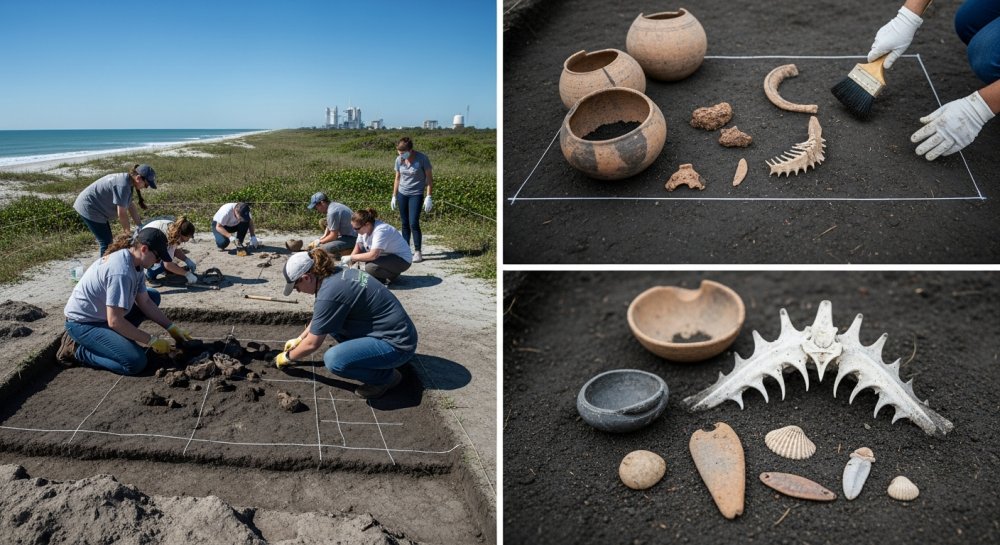
While most Americans think of Cape Canaveral as the home of space exploration, college students in Florida are discovering it was also home to a thriving Native American community that lasted over 600 years. University of Central Florida students and faculty are currently digging up the DeSoto site at Cape Canaveral Space Force Station, right along the Atlantic Ocean coast.
The site dates back to the Malabar II Period, which ran from roughly 900 to 1565 A.D. It sits on top of what archaeologists call black earth midden deposits — basically ancient garbage dumps that tell the story of how people lived.
Sarah “Stacy” Barber, an anthropology professor at the University of Central Florida, explained what these deposits reveal. “Middens contain the garbage that people left behind after undertaking their daily tasks,” she told Fox News Digital.
Getting and preparing food was the main daily activity for the Native Americans who lived there. “They didn’t farm, although research by Neil Duncan has shown that at least some people in the region had access to ground corn, which was being farmed by the Indigenous people of North Florida,” Barber said.
Instead of farming like their northern neighbors, the Cape Canaveral Native Americans relied heavily on what they could catch and gather locally. Some did have access to imported foods like corn and beans through trade.
Seafood was a major part of their diet — shark, fish, clams and other species that are still caught in Florida waters today. The remains of these meals have survived in the ancient refuse piles.
“We have found the refuse of many dozens of meals,” Barber said.
“We know from our finds this year at DeSoto that turtles, shark, black drum, and coquina clams were on the menu.”
The professor added that ancient people fished both the lagoon and the beachfront. “Once we can add in the plant remains, which take longer to process in a lab, we’ll know whether these animals were supplemented with plant foods like acorns and greenbriar,” she explained.
Evidence suggests these Indigenous people even seasoned their food — not so different from how we cook today. “We have made a number of really interesting finds this year,” Barber said.
One of the most striking discoveries is the complete vertebral column of a shark that the Native Americans would have eaten. Near the shark bones, archaeologists found something that has them completely puzzled.
“Something that is either a fossil or a whale bone near the shark,” Barber described. The anthropologist admitted the unidentified object “has really stumped us.”
“We look forward to figuring out what that is,” she said.
The dig has also turned up hundreds of pottery pieces and the remnants of at least one hearth where food was likely cooked. Barber said samples still need to be sent to an outside lab for radiocarbon dating to pinpoint exactly when these items were used.
Archaeologists discovered the tools Native Americans used to prepare their meals — conch shell hammers and shark tooth knives that prove these people were resourceful and skilled.
The remains show Indigenous people made deliberate choices about what they ate. Shark remains are common at the site, but there’s little evidence they hunted dolphins — suggesting cultural preferences or taboos.
The findings prove these Native Americans relied largely on local resources for centuries while maintaining contact with other tribes through trade networks. “The Indigenous people of Cape Canaveral lived in relatively dense communities and relied 100% on locally obtained food,” Barber explained.
“They did it for thousands of years, and they didn’t put the kind of stress on the local environment that we have in far less time.”
Far from struggling to survive, the community was well-connected and prosperous. “Our sites show an abundance and diversity of food, time to produce pottery when needed, and the opportunity to either travel or interact with people in distant regions,” Barber said.
“It was probably a comfortable, beachfront lifestyle.”
The professor said the excavations demonstrate how past and present exist side by side in America. “There are few places in the world highlighting the role of the past in the present than somewhere like Cape Canaveral, where the future of space flight literally sits atop and among Native American landscapes,” she noted.
Wyatt Matters
This story reminds us that long before government bureaucrats and coastal elites started lecturing working Americans about the environment, Native Americans lived sustainably on this land for thousands of years. They thrived without destroying what God gave them. Maybe instead of pushing green energy scams and carbon taxes, Washington should learn from the people who actually knew how to live in harmony with the land — and who built strong communities without welfare checks or government handouts.


-
 Entertainment3 years ago
Whoopi Goldberg’s “Wildly Inappropriate” Commentary Forces “The View” into Unscheduled Commercial Break
-

 Entertainment3 years ago
‘He’s A Pr*ck And F*cking Hates Republicans’: Megyn Kelly Goes Off on Don Lemon
-

 Featured3 years ago
US Advises Citizens to Leave This Country ASAP
-
 Featured3 years ago
Benghazi Hero: Hillary Clinton is “One of the Most Disgusting Humans on Earth”
-

 Latest News3 years ago
Nude Woman Wields Spiked Club in Daylight Venice Beach Brawl
-
 Featured3 years ago
Fox News Calls Security on Donald Trump Jr. at GOP Debate [Video]
-

 Entertainment3 years ago
Comedy Mourns Legend Richard Lewis: A Heartfelt Farewell
-

 Latest News3 years ago
Supreme Court Gift: Trump’s Trial Delayed, Election Interference Allegations Linger
R
May 15, 2026 at 10:20 am
When can we, at long last, get rid of the term “native American”?!? It is utterly meaningless, especially when one considers these people were here LONG before “America” even existed. Has anyone ever thought to ask what Indians, today, want to be called?