Latest News
January 1, Iran-Backed Pirates REVIVE Forgotten Tactic to Strangle Trillion-Dollar Oil Route

Wyatt’s Take
- Somali pirates are teaming up with Iran-backed Houthis to hijack oil tankers in the Red Sea, targeting over $1 trillion in annual trade that keeps America’s economy running.
- While our warships chase missiles, a massive security gap has opened up—pirates are swarming commercial vessels with GPS tech and coordination not seen in a decade.
- Saudi oil diverted from the dangerous Strait of Hormuz is now sitting duck cargo in the Red Sea, with crude prices near $115 a barrel making every hijacking worth tens of millions.
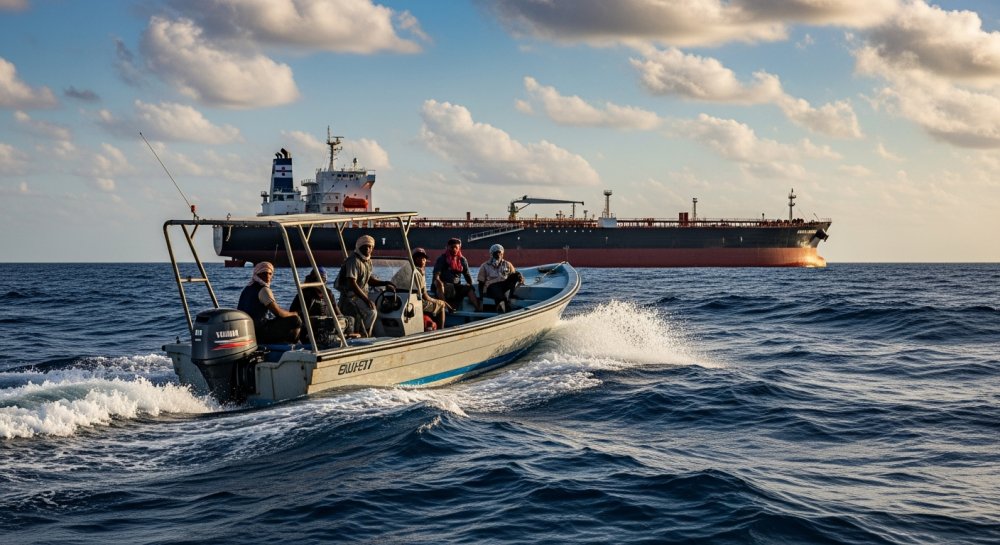
A wave of Somali piracy is triggering alarm bells across the Red Sea as security experts warn of a dangerous new alliance between pirates and Iran-backed Houthi militants. The partnership threatens a critical oil route that moves more than $1 trillion in goods every year.
The warning comes after Yemen’s coast guard reported on May 2 that armed men hijacked an oil tanker off Shabwa and steered it toward the Gulf of Aden. The vessel has since been located with recovery efforts underway.
“There is a fundamental shift in the maritime center of gravity amid a new phase of maritime instability in the region,” Ido Shalev, chief operating officer at RTCOM Defense, told Fox News Digital.
“Somali and Houthi-linked groups are teaming up — using skiffs and new tech to strike ships with coordination not seen in a decade — while Saudi crude rerouted from the Strait of Hormuz has created a ‘target-rich environment for them,'” he added.
“There is an opportunistic alignment, with the Houthis providing geopolitical cover and advanced GPS and surveillance, and Somali groups providing the boots on the ground or skiffs on the water,” Shalev said.
With the MT Eureka taken off Shabwa, Shalev, a former Israeli naval officer, said what he called the “Somali model” had returned “with a vengeance.”
“This is a transactional collaboration, and in the exact area where the Houthis are active and would like to cause damage and support their IRGC sponsor,” he said before describing how pirates would hijack the entire ship and cargo, taking them to a secure anchorage “like Qandala or Garacad.”
“They then demand a ransom for the entire package: the vessel, the tens of millions of dollars in oil, and the crew,” he said.
The surge in regional risk is also made worse, Shalev said, by the instability of the Strait of Hormuz. As Iranian-backed threats continue in the Persian Gulf, global energy flows are being forced to shift.
“Due to the closure and instability of the Strait of Hormuz, Saudi Arabia has diverted millions of barrels of crude per day through its East-West pipeline to the Red Sea port of Yanbu,” the former Israeli naval officer said.
“This creates a target-rich environment in a sector that was previously a backbound route. With Brent Crude prices surging — peaking near $115/bbl this quarter — the prize for a successful hijacking has never been higher.”
The risk level in waters off Somalia was recently upgraded to “substantial” following a wave of hijackings and attempted attacks that began April 21, according to Windward AI and alerts from the U.K. Maritime Trade Operations.
At least three vessels were hijacked within days: a Somali-flagged fishing boat on April 21, followed by the Palau-flagged tanker Honour 25, and, by April 26, a general cargo ship seized and redirected to Garacad.
Shalev, who served as the lead architect for Nigeria’s “Falcon Eye” project—a surveillance system that successfully reduced piracy in those waters to 0%—warned that the distraction of global warships is being exploited.
“Because international naval forces are preoccupied with missile threats, a ‘security vacuum’ has now opened in the region, so pirates can travel vast distances in skiffs to board vulnerable commercial vessels,” he said.
“Somali piracy, which had been suppressed for years, has seen this sharp resurgence that also correlates perfectly with the Houthi crisis in the Red Sea and Gulf of Aden,” Shalev said.
The Red Sea carries 12% to 15% of global trade and about 30% of container traffic, moving over $1 trillion in goods annually, including oil and LNG.
“The current crisis proves that you cannot ‘patrol’ your way out of this; you have to see the threat before it ever reaches the ship,” Shalev said.
Why It Matters
When Iran’s proxies team up with pirates to choke off the world’s oil supply, American families pay the price at the pump. Every hijacked tanker means higher gas prices, more expensive groceries, and a weaker economy. This is what happens when our enemies sense weakness—they don’t back down, they double down. We need strength on the world stage, not empty patrols that leave trillion-dollar trade routes wide open to thugs and terrorists.


-
 Entertainment3 years ago
Whoopi Goldberg’s “Wildly Inappropriate” Commentary Forces “The View” into Unscheduled Commercial Break
-

 Entertainment3 years ago
‘He’s A Pr*ck And F*cking Hates Republicans’: Megyn Kelly Goes Off on Don Lemon
-
 Featured3 years ago
US Advises Citizens to Leave This Country ASAP
-
 Featured3 years ago
Benghazi Hero: Hillary Clinton is “One of the Most Disgusting Humans on Earth”
-

 Latest News3 years ago
Nude Woman Wields Spiked Club in Daylight Venice Beach Brawl
-
 Featured3 years ago
Fox News Calls Security on Donald Trump Jr. at GOP Debate [Video]
-

 Entertainment3 years ago
Comedy Mourns Legend Richard Lewis: A Heartfelt Farewell
-

 Latest News3 years ago
Supreme Court Gift: Trump’s Trial Delayed, Election Interference Allegations Linger
Norbert Sevilla
May 3, 2026 at 7:56 pm
This doesn’t make sense. We find,drill, transport and refine our own oil product within the US.
So how does that affect us with what is happening in the gulf. So why our we paying high gas prices
Nick from Florida
Al
May 4, 2026 at 10:46 am
Because others are now coming to the States to buy oil, increasing US demand.
Jacqwayne
May 4, 2026 at 10:55 am
The emphasis on refining oil in the U.S. has been for the ‘Dirty’ crude from other countries. They are not prepared to refine the light crude found in this country.
Calcfan
May 3, 2026 at 8:04 pm
What are the consequences if these smuggler boats are blown out of the water in international waters?
Tom Spangler
May 4, 2026 at 8:42 am
Not really a problem. A few accurate shooters on each ship can neutralize the threat before it gets close enough to do harm.
Harry
May 4, 2026 at 10:24 am
People need to wake up. If you don’t do the crime, you don’t have to worry about getting blown away. Weather it’s breaking into someone’s house or attacking a ship. Put them down hard and the next ones might think twice.