Christianity
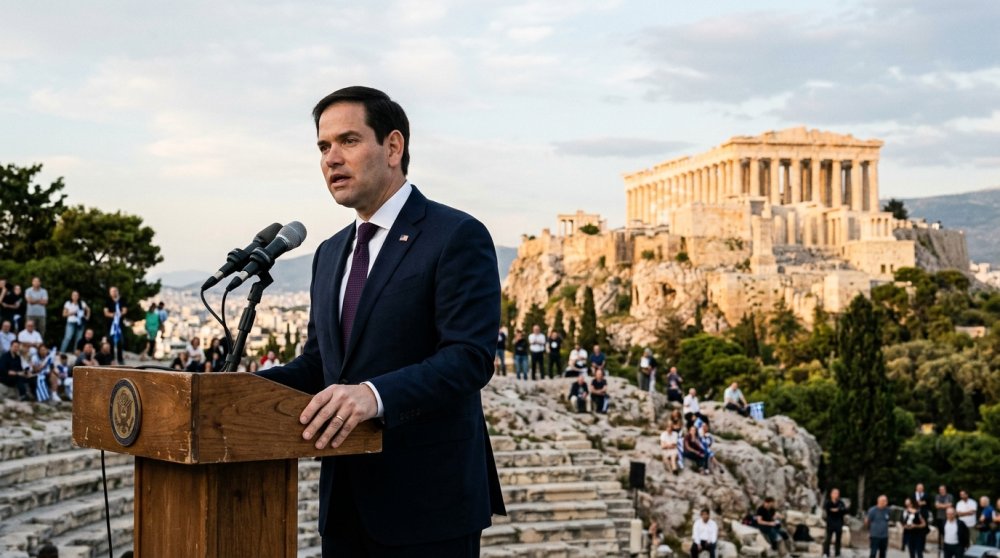
January 1, Rubio Stands Firm for Western Values in Athens

Wyatt’s Take
- Marco Rubio delivered a clear call to defend Western civilization from shame and decline.
- The speech highlights that American freedom comes from a long line of belief in individual dignity and law.
- Immigrants who chose this country know its values are worth protecting against progressive attacks.
When Secretary of State Marco Rubio opened his address in Athens, he noted that great ruins lie across the world, “but the Acropolis is different.” I knew exactly what he meant. I grew up among ruins, and in Egypt, you learn early that greatness can die.
The pyramids still stand, magnificent but silent. These are monuments to a civilization whose heirs no longer speak its language or honor its dogma. A ruin is something the living visit, but a civilization is something the living must defend.
Rubio’s October 7 speech from the Pnyx, with the Parthenon behind him, is one of the finest foreign policy addresses in recent memory. This speech deserves to be studied in classrooms and handed to every Westerner who has been taught to apologize for their inheritance.
It answers the question beneath every policy fight: does the West still believe it is worth defending? Rubio traced a long decline of nerve. He said the West came to feel ashamed of the very things that made it exceptional.
“Nationalism” became a dirty word. Monuments came down. Children were taught to be embarrassed by the countries they would inherit. His sharpest line was about a culture that builds downward, shaming meritocracy, and designing standards so no one loses, holding the exceptional “hostage to the average, the ordinary, the mediocre.”
I have watched this from both sides of the Atlantic, and I can tell you it is a luxury belief. Only people who have never lived without the West’s gifts could find them shameful. I did not come to America for a country that apologizes for itself.
I came because I had seen and heard that here humans are not mere numbers but are valued, honored, and protected. Where I grew up, a person’s worth often depends on which family, sect, or religion he was born into.
In America, I found a country that holds, as a founding conviction, that every person is made with dignity and bears rights no government grants and none may revoke. I also came because I wanted to be a Christian, or anything else I chose, without being a second-class citizen.
That is not a small thing. Where I come from, inequality before the law isn’t an accident of bad rulers; it’s a long inheritance, and entire communities still live under its weight. The West offered something I had never seen: a public square where my faith was not a liability, and my neighbor’s disbelief was not a crime.
Where did that come from? Not from nowhere. It came from Athens’ conviction that the world can be understood, from Rome’s devotion to law, from Christendom’s teaching that every soul matters, and from English-speaking peoples who learned to bind their rulers.
In his masterpiece speech, Rubio called this lineage a “common anthropology,” a shared view of man and his place in the world. Rubio is right. Our freedom is the fruit of that tree.
When progressive activists call it a rotten tree, they are chopping at the branch I am sitting on. He also emphasized that our age finds almost scandalous: heroism, honor, and duty are not universal.
“They are not,” he said, calling them the product of a distinct character. He set the Western hero, willing to die for his cause but not worshipping death, against the radical mullahs of Iran, whose cult of death hails child suicide bombers as national heroes.
Those who insist that all cultures are equal or interchangeable have never examined what different civilizations actually honor. Rubio saw this plainly, and plainness is rare in diplomacy.
Progressives will cry “nationalism,” as if the word settled the matter, but listen to what he actually said: There is “nothing selfish or wrong” about loyalty to our own nation, and indeed nations “need not abandon their distinct identities in order to recognize their common interests.”
A man who loves his own home is the neighbor you want in a crisis, and an alliance of proud nations will outlast a committee of embarrassed ones. Here is what the “shame” traders never grasp. The immigrant is the West’s most honest auditor.
We chose it. We saw the West is best. We left the familiar and crossed oceans, legally and eagerly, often at great cost, because we had compared the alternatives. Nobody risks everything to reach a civilization that is truly shameful or contemptible.
The Athenians who returned to the burned Acropolis did not weep over their failures. They buried the rubble and raised the Parthenon. That is the spirit Rubio is calling us back to, and it is the spirit of any people who refuse to become ruins.
So let this speech be taught. Let it be read in Paris, Berlin, and London, and in every American high school where a teenager is learning to loathe his own country or despise his own culture.
And let those of us who chose America say what we know: this inheritance is not a source of shame — it is the reason we came, and it is worth defending.
Wyatt Matters
Middle America knows that the values Rubio defended are the same ones that built strong families, safe neighborhoods, and a country worth passing down to the next generation.


-
 Entertainment3 years ago
Whoopi Goldberg’s “Wildly Inappropriate” Commentary Forces “The View” into Unscheduled Commercial Break
-

 Entertainment3 years ago
‘He’s A Pr*ck And F*cking Hates Republicans’: Megyn Kelly Goes Off on Don Lemon
-

 Featured3 years ago
US Advises Citizens to Leave This Country ASAP
-
 Featured3 years ago
Benghazi Hero: Hillary Clinton is “One of the Most Disgusting Humans on Earth”
-

 Latest News3 years ago
Nude Woman Wields Spiked Club in Daylight Venice Beach Brawl
-
 Featured3 years ago
Fox News Calls Security on Donald Trump Jr. at GOP Debate [Video]
-

 Entertainment3 years ago
Comedy Mourns Legend Richard Lewis: A Heartfelt Farewell
-
 Latest News3 years ago
Supreme Court Gift: Trump’s Trial Delayed, Election Interference Allegations Linger