Sports
January 1, EXPOSED: Why NFL Refs Face Same Brutal Training As Pro Athletes

Wyatt’s Take
- NFL officials must pass the same physical fitness tests as college and pro athletes, proving the job demands real athletic conditioning.
- Officials cover six miles per game with constant stops, starts, lateral moves, and backpedaling that punish knees and shoulders over decades.
- Years of wear force many refs into multiple joint replacements, yet they still return to the field because proper conditioning keeps them in position to make accurate calls.
During the Houston Texans and Jacksonville Jaguars matchup in London on Oct. 18, NFL umpire Larry Smith suffered a non-contact injury while attempting to retrieve a football on the wet grass at Wembley Stadium.
Smith slipped, fell backward and attempted to get back on his feet before collapsing again. Medical personnel rushed onto the field, and he was eventually carted off.
NFL referee Larry Smith carted off the field during the London game with a non-contact knee injury. Wishing him a speedy recovery 🙏 https://t.co/5vFExO6aaD
— Bussin’ With The Boys (@BussinWTB) October 18, 2026
🚑 Umpire Larry Smith was taken off the field at Wembley Stadium in a cart after he slipped and injured himself. Get well soon! https://t.co/cuYqdOUbLq
— René Bugner (@RNBWCV) October 18, 2026
Flex on ’em, Hochuli! 💪
Longtime @NFL referee Ed Hochuli retires and will be replaced by his son, Shawn. https://t.co/w6XpvLELnc
— Sunday Night Football on NBC (@SNFonNBC) March 6, 2018
“NFL referee Larry Smith carted off the field during the London game with a non-contact knee injury. Wishing him a speedy recovery 🙏”
“🚑 Umpire Larry Smith was taken off the field at Wembley Stadium in a cart after he slipped and injured himself. Get well soon!”
Shortly afterward, Football Zebras reported that Smith had suffered a torn quadriceps muscle and would miss the remainder of the season.
The injury highlighted a physical challenge that rarely receives much attention in professional football.
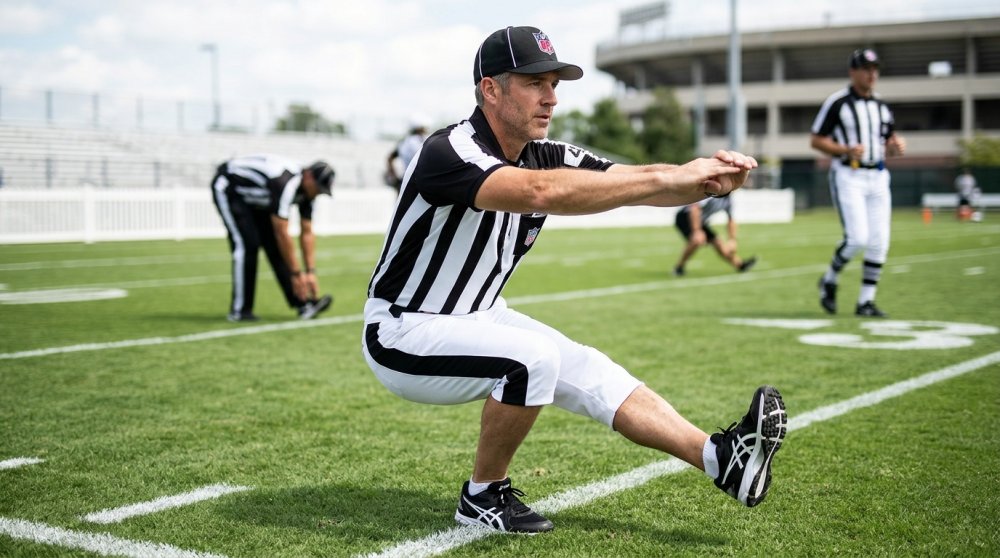
While the players take most of the punishment, NFL officials spend their Sundays sprinting, backpedaling and constantly changing directions to keep up with some of the best athletes in the world. Preparing their bodies for that responsibility requires far more than showing up on Sundays with a whistle.
Preseason training
It turns out referees don’t just show up to training camp with a whistle and a fresh pair of black-and-white stripes.
According to Bill Topp, president of the National Association of Sports Officials (NASO), the NFL has established physical fitness standards that officials must satisfy before taking the field.
“They have preseason requirements that the NFL requires them to pass certain fitness tests and meet certain requirements, including weight and speed and agility,” Topp told Sport & State. “They’ve got benchmarks based on age, obviously, because some of the younger officials in the NFL have a different requirement than some of the veteran officials in the NFL.”
Those requirements are intended to ensure officials can consistently put themselves in position to make the correct calls.
“What we call mechanics is our positioning, and you have to be able to get in position to be able to see the plays correctly,” Topp explained.
For Austin Ardrey, a former collegiate strength and conditioning coach who founded Runnin’ Ref, a training program specifically designed for sports officials, that preparation isn’t much different from what professional athletes experience.
“We train officials the same way that collegiate and professional athletes train,” Ardrey said.
His program emphasizes three primary components: strength training, conditioning and mobility. That includes everything from traditional weightlifting to high-intensity interval training, injury prevention exercises and movements designed to simulate what officials encounter during games.
The preparation also changes throughout the year.
Ardrey separates training into three phases: offseason, preseason and regular season. During the offseason, the focus is on gradually building strength, endurance and mobility. As preseason games and scrimmages begin, workouts are adjusted to account for the increased activity on the field.
“The big thing that we try to talk to our officials about is that training is structured. It’s not just exercise,” Ardrey said. “We’re not just out here to break a sweat.”
Few people understand that commitment better than Rick Patterson, a recently retired NFL official who spent 30 seasons in the league, primarily working as a side judge and field judge, and officiated three Super Bowls.
During his early years, Patterson focused heavily on weightlifting, drawing inspiration from former NFL referee Ed Hochuli, who became well known for his muscular physique.
“Flex on ’em, Hochuli! 💪”
However, as Patterson grew older, his routine shifted from heavier weightlifting toward lighter weights and higher repetitions to accommodate the physical wear on his body. The one thing that never changed was his commitment to staying in shape.
“I never got out of shape, so I never had to get in shape,” Patterson said.
That year-round preparation was important because the physical demands only intensified once the season began.
The grind of the season
Six miles.
That’s approximately how much ground Patterson said he covered during an average NFL game throughout his career.
While the distance varies depending on the officiating position, Patterson spent much of his career working downfield, requiring him to cover considerable ground throughout the game.
But traveling six miles throughout an afternoon isn’t quite the same as taking a leisurely walk around the neighborhood.
“It’s stop, start, stop, start,” Patterson explained. “You move laterally, you move backwards, you turn, you twist, you jump. I mean, it’s just a tremendous amount of movement.”
The constant acceleration, deceleration and changes of direction place considerable stress on an official’s muscles and joints, creating injury risks that can be difficult to eliminate through conditioning alone.
Ardrey identified Achilles and patellar tendinitis, hamstring and calf strains, and plantar fasciitis among the common problems officials experience. His training programs address those risks through specific exercises, including single-leg squats, lateral squats, ankle isometrics and heel drops designed to strengthen areas susceptible to injury.
The preparation doesn’t stop once the games begin.
For officials working on Sundays, Ardrey recommends an active recovery day Monday, followed by a more demanding strength training session Tuesday. The remaining days are filled with lighter conditioning, mobility work and activation exercises ahead of the next game.
The goal is to maintain the strength and conditioning developed throughout the offseason without exhausting the body before another physically demanding Sunday.
“The idea here is not to let go of all the things they built upon over the course of the offseason,” Ardrey said. “Once that happens and they lose strength or they lose fitness ability, then the injury risk really goes up.”
Patterson knows firsthand how difficult that balance can become over a lengthy career.
After years of intense weight training, his shoulders began deteriorating to the point where a doctor recommended replacing both joints.
He initially attempted to manage the pain through cortisone injections, but the relief gradually became shorter and shorter.
Eventually, the pain became so severe that Patterson needed assistance getting dressed for a playoff game in Denver.
“The guys had to help me get dressed,” Patterson recalled.
“I worked a playoff game on Sunday, had a shoulder replacement on Wednesday,” Patterson said. “And then 11 weeks later, I had the other shoulder replaced.”
Despite undergoing two shoulder replacements within roughly three months, Patterson returned to the field that August. He would eventually undergo two knee replacements as well, injuries he attributed to years of physical wear and overuse rather than collisions with players.
Patterson’s experience demonstrates how difficult it can be to maintain the same physical standards throughout a career spanning multiple decades.
While serious injuries like Smith’s are relatively uncommon, Topp explained that officials face multiple risks beyond simply pulling a muscle.
Officials working near the middle of the field must account for accidental collisions with players, including potential concussions, while those working downfield frequently backpedal, shuffle laterally and suddenly reverse directions.
Topp also credited the NFL with placing greater emphasis on officials’ physical well-being over the past decade, including access to trainers, rehabilitation specialists and other fitness resources.
It’s a reminder that although officials aren’t the ones making tackles or carrying the football, their bodies still endure the consequences of working an NFL game.
Misunderstood athleticism
Maybe the biggest misconception surrounding NFL officials is that they aren’t athletes themselves.
That’s something Ardrey strongly disagrees with.
“They sprint, they stop, they change direction,” Ardrey said. “They have to focus for hours at a time, and they don’t get a break on third down like some of the players do.”
That last point is particularly interesting.
An NFL player can rotate out of the game, rest on the sideline or be replaced by another player when fatigued. Officials, meanwhile, must remain on the field, maintain their positioning and make split-second decisions from the opening kickoff to the final whistle.
They also face the challenge of keeping up with a game that has become increasingly spread out and dependent on speed.
“Football used to be more between the tackles, and now it’s evolved and it’s spread out all over the field,” Ardrey said.
That evolution has forced officials to cover more ground and repeatedly perform explosive movements. The challenge becomes even greater with age. Officials always told Ardrey the same phrase.
“The players stay the same age and we keep getting older.”
But the physical requirements are only part of the equation.
Patterson explained that one of the most difficult aspects of officiating is the limited opportunity to practice in real game situations.
Unlike baseball officials, who might work several games in a week, NFL officials generally have one opportunity each week to apply their preparation on the field.
“There’s no way to put in the actual practice until you’re actually out there on the field,” Patterson said.
Instead, much of their preparation comes through film study, reviewing rules, attending meetings and analyzing situations that could arise during a game.
According to NFL Football Operations, officials can spend more than 30 hours each week reviewing video, studying the rulebook and participating in evaluations and crew meetings.
For many, officiating isn’t their only professional responsibility. Patterson spent much of his NFL career working in corporate banking, balancing his responsibilities to his employer with his work on Sundays.
He compared the weekly transition to something out of a superhero movie.
“I put on one suit and I wore it five days of the week,” Patterson recalled. “Then I go into the phone booth on Friday night, change … into my referee uniform.”
By Sunday night, it was back to the phone booth and his responsibilities away from football.
Topp believes that disconnect between what fans see on Sundays and the work happening throughout the week contributes to a fundamental misunderstanding of the profession.
“Most people think we just come down from Mars for the day on Sunday, work the game and go back to Mars,” Topp said.
“But the reality is it takes decades of lots of hard work, and the hours spent are truly remarkable at that level in rule study, mental preparation, film study, watching games, and then of course doing the games themselves.”
It also explains why Topp believes physical conditioning contributes to more than just preventing injuries.
Officials who can consistently keep up with the action are better positioned to make accurate calls, which ultimately strengthens confidence in the officiating itself.
“They are athletes on the field, even though most people don’t think of them that way,” Topp said.
Nobody is suggesting that NFL referees endure the same physical punishment as the players they officiate. They aren’t intentionally absorbing tackles from 300-pound linemen or taking hits from defenders running at full speed. But that doesn’t mean the job is physically easy. Between the year-round conditioning, demanding weekly schedule, constant movement and injury risks, officiating requires far more preparation than most fans realize.
The next time you see a referee sprinting down the sideline alongside a player, you should probably think a little less about the stripes and a little more about the work that went into keeping up.
Wyatt Matters
Heartland families know the value of hard work, discipline, and showing up prepared. When officials keep themselves strong and ready, they earn the trust of fans who want fair calls and respect for the game.


-
 Entertainment3 years ago
Whoopi Goldberg’s “Wildly Inappropriate” Commentary Forces “The View” into Unscheduled Commercial Break
-

 Entertainment3 years ago
‘He’s A Pr*ck And F*cking Hates Republicans’: Megyn Kelly Goes Off on Don Lemon
-

 Featured3 years ago
US Advises Citizens to Leave This Country ASAP
-
 Featured3 years ago
Benghazi Hero: Hillary Clinton is “One of the Most Disgusting Humans on Earth”
-

 Latest News3 years ago
Nude Woman Wields Spiked Club in Daylight Venice Beach Brawl
-
 Featured3 years ago
Fox News Calls Security on Donald Trump Jr. at GOP Debate [Video]
-

 Entertainment3 years ago
Comedy Mourns Legend Richard Lewis: A Heartfelt Farewell
-

 Latest News3 years ago
Supreme Court Gift: Trump’s Trial Delayed, Election Interference Allegations Linger