Latest News
January 1, Ancient Secrets EMERGE From Railway Dig — What Romans Left Behind Is Jaw-Dropping

Wyatt’s Take
- Over 1,000 ancient artifacts spanning thousands of years were uncovered in the Czech Republic during railway construction — proof that modern progress doesn’t have to erase our past
- Archaeologists discovered a rare Roman-era tool for making metal wire, possibly used to craft chain mail — a stunning glimpse into ancient craftsmanship and military ingenuity
- Excavations revealed Bronze Age homes, graves with six human skulls, and evidence of specialized bronze workshops — this wasn’t just a settlement, it was a thriving industrial hub
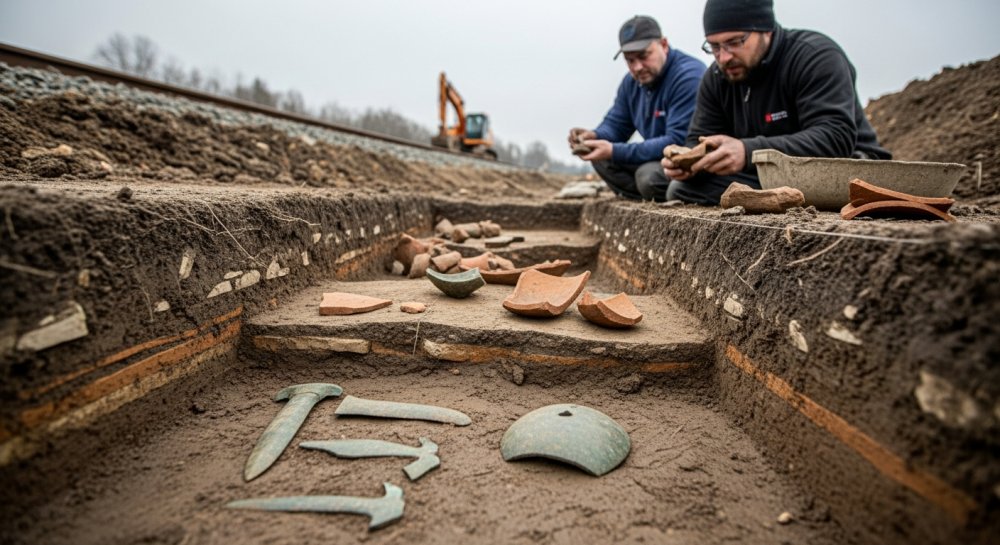
Archaeologists in Central Europe have struck gold — or rather, bronze and ancient Roman treasures — while preparing ground for a high-speed railway project in the Czech Republic. Over 1,000 artifacts spanning from the Early Bronze Age through the Roman era have emerged from the soil, painting a picture of civilizations that thrived thousands of years ago.
The Archaeological Center Olomouc announced the discoveries in April, following excavations along a three-quarter-mile stretch between the towns of Nezamyslice and Kojetín in the Haná River valley. Work took place between April and October 2025.
Nikola Jandová, a spokesperson for the center, said the site “ranks among exceptionally rich settlement complexes in this part of the Haná region.”
The findings include remains from two Bronze Age cultures — the Věteřov and Urnfield cultures — along with evidence of the Iron Age La Tène culture. The earliest settlement dates to the Věteřov culture, with researchers uncovering wooden home remains from approximately 1800-1500 B.C.
“Following destructive fires, fragments of wall plaster survived as reddened fired clay, known as daub,” the statement noted.
“Some fragments show smoothed surfaces with traces of external decoration, while others preserve impressions of wattle on the inner side.”
Archaeologist Pavel Moš explained that house details were remarkably preserved in the daub, with surface finishing traces still visible after millennia.
Two Věteřov graves were also discovered, including one containing both an adult and a child. These remains will undergo further analysis to reveal more about life during this period.
From the later Urnfield culture period (1300-800 B.C.), excavators unearthed four graves — and one particularly mysterious burial containing six human skulls “found placed side by side within the fill of the feature.” The arrangement suggests a ritual or ceremonial purpose that researchers are still working to understand.
Evidence of ancient industry also emerged. Archaeologists found crucible fragments and stone molds used to craft bronze objects, along with bronze artifacts including axes, pins, a bracelet and a knife.
“These finds date to the end of the Bronze Age and the Early Iron Age and indicate the presence of a specialized bronze-working workshop,” the statement read.
The Roman-era discoveries proved especially fascinating. A lime kiln, likely used by Germanic tribes during the first to fourth centuries A.D., was uncovered — probably employed for wall finishing or pottery decoration.
But the most remarkable find was a Roman drawplate, a tool used to pull and thin metal wire. Such discoveries are extremely rare in Central Europe, making this a significant contribution to understanding Roman technological reach.
Though well-preserved, archaeologist Pavel Moš noted that “corrosion residues are present in its perforations, and traces of drawn metal wires may be preserved.”
He added, “The drawplate will be subjected to spectrometric analysis to determine the material of the wire.”
The drawn wire, he explained, “could have been used, for example, in the production of chain mail.”
All artifacts will undergo laboratory analysis and preservation, with results expected to be released over time. This discovery follows another major find by the same archaeological team last year, when they uncovered multiple military graves during highway construction, including one from the 1745 Battle of Žďár.
Why It Matters
This discovery reminds us that human ingenuity and craftsmanship aren’t modern inventions — our ancestors built thriving communities, mastered metalworking, and created tools that lasted millennia. While politicians waste billions on pet projects, here’s proof that real infrastructure can coexist with preserving our heritage. These aren’t just old objects — they’re a testament to the endurance of civilization itself, something worth protecting as we build for the future.


-
 Entertainment3 years ago
Whoopi Goldberg’s “Wildly Inappropriate” Commentary Forces “The View” into Unscheduled Commercial Break
-

 Entertainment3 years ago
‘He’s A Pr*ck And F*cking Hates Republicans’: Megyn Kelly Goes Off on Don Lemon
-

 Featured3 years ago
US Advises Citizens to Leave This Country ASAP
-
 Featured3 years ago
Benghazi Hero: Hillary Clinton is “One of the Most Disgusting Humans on Earth”
-

 Latest News2 years ago
Nude Woman Wields Spiked Club in Daylight Venice Beach Brawl
-

 Entertainment2 years ago
Comedy Mourns Legend Richard Lewis: A Heartfelt Farewell
-
 Featured3 years ago
Fox News Calls Security on Donald Trump Jr. at GOP Debate [Video]
-

 Latest News2 years ago
Supreme Court Gift: Trump’s Trial Delayed, Election Interference Allegations Linger