Breaking News
January 1, Federal Judge Just Dealt DEVASTATING Blow to State Executions — Critics Already Celebrating

Wyatt’s Take
- Federal judge permanently blocks Alabama nitrogen gas execution hours after appeals court reversal, ruling method unconstitutionally cruel despite state maintaining it’s legal
- Left-wing death penalty opponents and criminal rights activists celebrating as judge orders state to use firing squad alternative — case likely headed to Supreme Court
- Alabama used nitrogen gas for eight total U.S. executions since 2024, with convicted killer set for execution Thursday now spared by last-minute judicial intervention
A federal judge on Tuesday permanently blocked Alabama from executing death row inmate Jeffrey Lee with nitrogen gas after finding that it violates the U.S. Constitution’s ban on cruel and unusual punishment. The ruling came just hours before Lee’s scheduled execution on Thursday.
U.S. District Judge Emily C. Marks handed down the decision after an appeals court reversed her initial finding that the controversial execution method was constitutional. She permanently barred the state from using nitrogen gas to execute Jeffrey Lee, 49, who has been on death row since his 1998 conviction.
The judge wrote that the appeals court found the method carried “a substantial risk of serious harm.” A three-judge panel from the 11th U.S. Circuit Court of Appeals on Monday said the three minutes that it could take for an inmate to lose awareness is an “intolerable” time frame.
“Given the suffering that would likely take place under Alabama’s nitrogen hypoxia protocol,” the appeals court stated.
Marks also ruled that the state could change the form of execution to Lee’s preferred method, which is a firing squad. Inmates challenging execution methods must suggest an alternative method under current law.
“Therefore, Lee has shown by a preponderance of the evidence that the protocol constitutes cruel and unusual punishment in violation of the Eighth Amendment,” Marks wrote.
Marks’ order blocks only the state from executing Lee by nitrogen gas. The state has two other authorized execution methods: lethal injection and the electric chair. She said Lee is “not entitled to an injunction barring the state from executing him using one of those methods.”
Alabama Attorney General Steve Marshall’s office is appealing the decision, according to a new court filing. Alabama officials have maintained that the method is constitutional and humane.
The issue appears likely bound for the U.S. Supreme Court, which has never ruled a state’s execution method to be unconstitutional. Conservative justices have historically been reluctant to micromanage state execution protocols.
“Were Alabama to adopt firing squad as a method of execution, that method would likely be challenged as well. Indeed, there is likely no method — no matter how humane — that would be immune to constitutional challenge. But the Constitution does not guarantee a painless death, and human life cannot be purposefully extinguished without some risk of pain. The Court, the condemned, and the State must all confront that sobering reality,” Marks wrote in her ruling.
Alabama began using nitrogen gas for executions in January 2024, when convicted killer Kenneth Eugene Smith became the first person in the country to be executed using that method. The state adopted the protocol after pharmaceutical companies began refusing to provide lethal injection drugs.
The execution method, which involves strapping a respirator onto the inmate’s face and replacing breathable air with pure nitrogen gas, causing death by lack of oxygen, has been criticized by opponents as inhumane and torturous. Supporters argue it’s more humane than other methods.
“Three minutes of conscious suffocation is torturous. If that doesn’t violate the constitution, let alone international law, nothing would,” Bernard Harcourt, a professor at Columbia University Law School and who represents one of several other Alabama inmates challenging the method as unconstitutional, said.
Nitrogen has been used in eight executions in the U.S., with seven of them in Alabama and one in Louisiana. Lee was set to become the ninth person executed with nitrogen before Marks’ order came down.
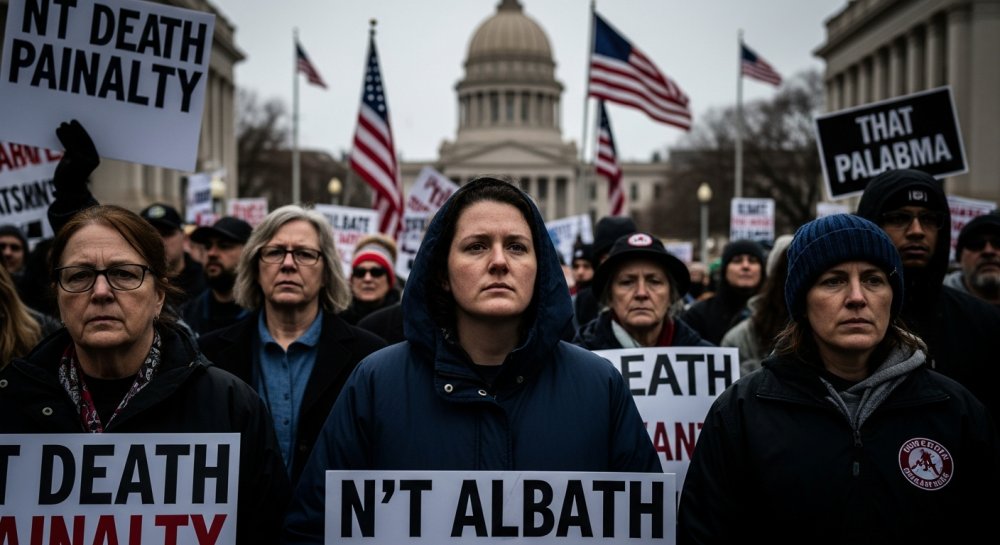
Opponents of the death penalty and critics of the controversial execution method praised Marks’ ruling on Tuesday, calling it a victory for human rights. Death penalty supporters argue the ruling prioritizes criminals over victims’ families.
“I pray that we are witnessing the collapse of this horrific method nationwide,” said the Rev. Jeff Hood, who served as spiritual adviser at two nitrogen executions.
Lee is being held at Holman Correctional Facility in Atmore for his conviction of two counts of capital murder for killing Jimmy Ellis and Elaine Thompson while robbing a pawnshop on Dec. 12, 1998. Prosecutors said Lee entered Jimmy’s Pawnshop with a sawed-off shotgun and shot Ellis, who was the owner of the store, and Thompson, an employee at the business.
A jury voted 7-5 that Lee should be sentenced to life imprisonment, but a judge overrode that recommendation and sentenced him to death. That judicial override practice was legal at the time.
Alabama later ended the ability of a judge to disregard a jury’s sentencing decision in death penalty cases.
Wyatt Matters
When cold-blooded killers get more sympathy from the courts than their victims’ families, something’s broken. This man walked into a pawnshop with a sawed-off shotgun and murdered two people in cold blood. Now lawyers are arguing about whether his execution might cause him three minutes of discomfort. The families of Jimmy Ellis and Elaine Thompson have waited over 25 years for justice, and activist judges keep moving the goalposts. The Constitution doesn’t guarantee criminals a pain-free death — it guarantees law-abiding citizens the right to life, liberty, and the pursuit of happiness. Those victims never got that chance.


-
 Entertainment3 years ago
Whoopi Goldberg’s “Wildly Inappropriate” Commentary Forces “The View” into Unscheduled Commercial Break
-

 Entertainment3 years ago
‘He’s A Pr*ck And F*cking Hates Republicans’: Megyn Kelly Goes Off on Don Lemon
-

 Featured3 years ago
US Advises Citizens to Leave This Country ASAP
-
 Featured3 years ago
Benghazi Hero: Hillary Clinton is “One of the Most Disgusting Humans on Earth”
-

 Latest News3 years ago
Nude Woman Wields Spiked Club in Daylight Venice Beach Brawl
-
 Featured3 years ago
Fox News Calls Security on Donald Trump Jr. at GOP Debate [Video]
-

 Entertainment3 years ago
Comedy Mourns Legend Richard Lewis: A Heartfelt Farewell
-

 Latest News3 years ago
Supreme Court Gift: Trump’s Trial Delayed, Election Interference Allegations Linger
Juan
June 10, 2026 at 8:04 am
So use the ‘firing squad’ on schedule. The fact that the death penalty is carried out an average of 30 years after the crime is ‘cruel and unusual punishment’ to the victim’s family.
KEITH FOUNTAIN
June 10, 2026 at 8:06 am
I beleive that you should be executed in the same manner in which you murdered your victim. Eye for an eye.
Cheryl Fitzsimmons
June 10, 2026 at 9:37 am
Give me a break. What about the families pain & suffering? These female judges always have to put some “drama” in the mix. I’m getting sick of females in government that can’t do their job without interfering in some way that the presiding judge gave.