Latest News
January 1, America’s Power Grid Is Collapsing — And We Have No One Left Who Knows How To Fix It

Wyatt’s Take
- For 20 years, the utility industry assumed electricity demand would stay flat forever. They stopped training workers, stopped making equipment, and let entire skill sets vanish. Now demand is surging and we’ve lost the know-how to keep the lights on.
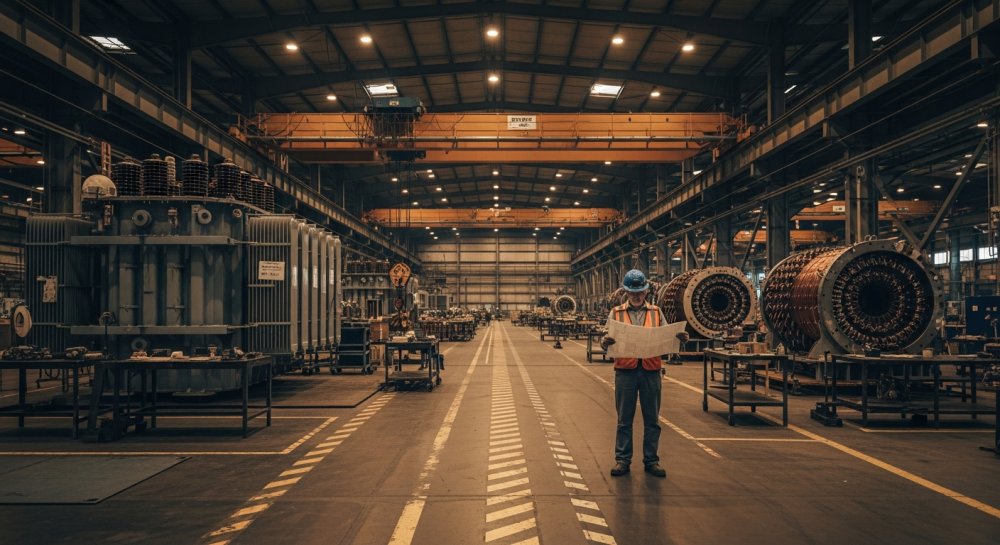
- 80% of our power transformers are now imported. The average transformer on the grid is 38 years old. Lead times stretch to two and a half years. Half the utility workforce is over 45 and heading for retirement. There’s literally nowhere in America to learn how to build these machines anymore.
- This isn’t just a supply chain problem — it’s a knowledge crisis. You can build a factory in two years, but you can’t train a master technician in two years. We hollowed out an entire industry and forgot that some skills can’t be Googled or downloaded.
For 20 years, electricity was the most boring business in America. And our industry built its whole infrastructure strategy around the assumption that things would stay that way.
The numbers tell the story. From 2010 to 2020, U.S. electricity consumption fell by roughly 1%.
LEDs, efficient motors and tightening appliance standards quietly cancelled out the electricity used by every new subdivision, factory and data hall. Demand was flat, and planners treated this as a permanent fact of life rather than as what it actually was: an intermission.
No-growth industries make choices that are perfectly rational, yet corrosive. You don’t fund apprenticeships when there’s no new capacity to staff.
You don’t keep spare metallurgical know-how on the payroll when nobody’s ordering. You don’t recruit ambitious 25-year-olds into a sector whose pitch is stable, essential, and never going anywhere.
So, the utilities didn’t. The transformer makers didn’t.
The steel mills didn’t. The workforce aged in place and the labor pipeline behind it ran dry.
We mistook a flat line for stability and in doing so, allowed a slow decay to occur. Then the line broke.
Since 2020, electricity consumption has reversed two decades of decline and climbed about 7%. Demand for large power transformers — the equipment through which nearly all of America’s electricity passes at some point — has surged 116% since 2019.
Data centers, reshoring, electrification and grid hardening all arrived in the same handful of years. They descended on an industry that had bought into the idea that it would never grow again.
Facing resurgent demand, we went looking for the people and the parts to meet it. And here is what we found: America had forgotten how to make the machines that keep the country alive.
Roughly 80% of the large power transformers the United States installs are now imported. The grain-oriented electrical steel at the heart of every one of them has but a single domestic producer.
Lead times for a standard power transformer have stretched to nearly two and a half years. The larger units that connect power plants to the grid run longer still.
Prices are up more than 77% since 2019. The average transformer already humming away on the American grid is 38 years old, and more than 70% of the fleet is past age 25.
We are simultaneously trying to replace an aging base and build an entirely new one. And we’re doing it with a supply chain we spent a generation hollowing out.
The hardware shortage gets the headlines. The human one is worse, because you can’t expedite it.
A person cannot, today, enroll anywhere in America to learn how to design or build a large power transformer. The handful of university power-engineering programs that survived the last two decades don’t teach it.
They were shrinking before the boom began as students chased software and AI instead.
The knowledge to wind a coil, design a core or run a high-voltage acceptance test is tribal. It’s passed hand-to-hand on a shop floor by master winders, test engineers or metallurgists who understand why a core behaves the way it does.
The expertise lives in people, much of it never written down. And roughly half the utility workforce is now over 45 with a large share eligible to retire this decade.
You can stand up a new transformer factory in a couple of years. You cannot conjure an experienced winder in a couple of years, and you can’t enroll one either.
That’s the asymmetry nobody priced in. Industrial capability is cheap to lose and brutally expensive to rebuild.
It took just 18 months of supply chain stress to expose the gap. It will take the better part of two decades to close it — and that’s the optimistic case where demand politely waits.
It won’t. Every credible forecast has load climbing through 2050.
We’ve finally admitted that electricity is as essential as water. But we did so too late to avoid disruption.
The fix is slow and unglamorous.
It means treating the grid as a growth industry again. That means apprenticeships, demand signals long enough for manufacturers to justify new lines, and a domestic materials base that isn’t one bad quarter at one steel plant away from seizing up.
It means capital flowing to electrical capacity, not just to the data centers that capacity will serve.
Most of all, it means abandoning the belief that quietly governed 20 years of disinvestment. The belief that because the lights stayed on, the people and the plants that keep them on would always be there.
The bill for two decades of treating an intermission as the end of the show has come due all at once.
Wyatt Matters
This is what happens when America stops making things and starts assuming someone else will always do it for us. For 20 years we let the skills disappear, let the factories close, let the next generation chase tech jobs instead of learning how to keep the power on. Now the whole system is held together by aging equipment and aging workers, and there’s no backup plan. If we want factories, data centers, and American manufacturing back on our soil, we’d better start rebuilding the workforce that makes it all possible — before the lights go out for good.


-
 Entertainment3 years ago
Whoopi Goldberg’s “Wildly Inappropriate” Commentary Forces “The View” into Unscheduled Commercial Break
-

 Entertainment3 years ago
‘He’s A Pr*ck And F*cking Hates Republicans’: Megyn Kelly Goes Off on Don Lemon
-

 Featured3 years ago
US Advises Citizens to Leave This Country ASAP
-
 Featured3 years ago
Benghazi Hero: Hillary Clinton is “One of the Most Disgusting Humans on Earth”
-

 Latest News3 years ago
Nude Woman Wields Spiked Club in Daylight Venice Beach Brawl
-
 Featured3 years ago
Fox News Calls Security on Donald Trump Jr. at GOP Debate [Video]
-

 Entertainment3 years ago
Comedy Mourns Legend Richard Lewis: A Heartfelt Farewell
-

 Latest News3 years ago
Supreme Court Gift: Trump’s Trial Delayed, Election Interference Allegations Linger
Steve Mitzner
August 7, 2026 at 10:18 am
Our Creator inspired, and founding father John Adams said it best: “Our Constitution was made only for a moral and religious people. It is wholly inadequate to the government of any other.” I.e. Not a Satan-inspired, Hell-bound mass baby-killing, mass-addicted, broken Church & Home neo-Sodom-Gomorrah LGBTQ-promoting world of today! We’re lucky God hasn’t wiped out our evil world again, as before!!!
Kenneth Chrosniak
August 7, 2026 at 11:03 am
So what do we do? What is to be done, or even started, in the short term to begin reversal? Or, foolishly thinking, should I ask ChatGPT?
Dennis
August 7, 2026 at 2:31 pm
This is truly mind boggling that this was allowed to happen. Was there nobody with an ounce of foresight in this industry?
I guess when we get to focused on pronouns and gender identity the important things are allowed to rot.