Breaking News
January 1, Historic Political Earthquake Rocks Germany as Establishment Faces Total Collapse

Wyatt’s Take
- Germany’s anti-establishment party just delivered the kind of victory that has mainstream politicians in complete meltdown mode — doubling their vote share and exposing how badly traditional parties have lost touch with everyday citizens.
- While elites panic and throw around extremism accusations, regular Germans are sending a crystal-clear message: they’re fed up with open borders, economic decline, and leaders who prioritize globalist agendas over their own people’s security and prosperity.
- This isn’t just about one regional election — it’s about working families across the West rejecting the failed policies that have made them poorer, less safe, and voiceless in their own countries.
The Alternative for Germany party, known as AfD, scored a massive victory in a regional election on Sunday, delivering a crushing blow to German Chancellor Friedrich Merz’s center-right Christian Democratic Union. The establishment is reeling.
Merz’s party faced a catastrophic result in the eastern state of Saxony-Anhalt, where voters rejected decades of the same failed leadership.
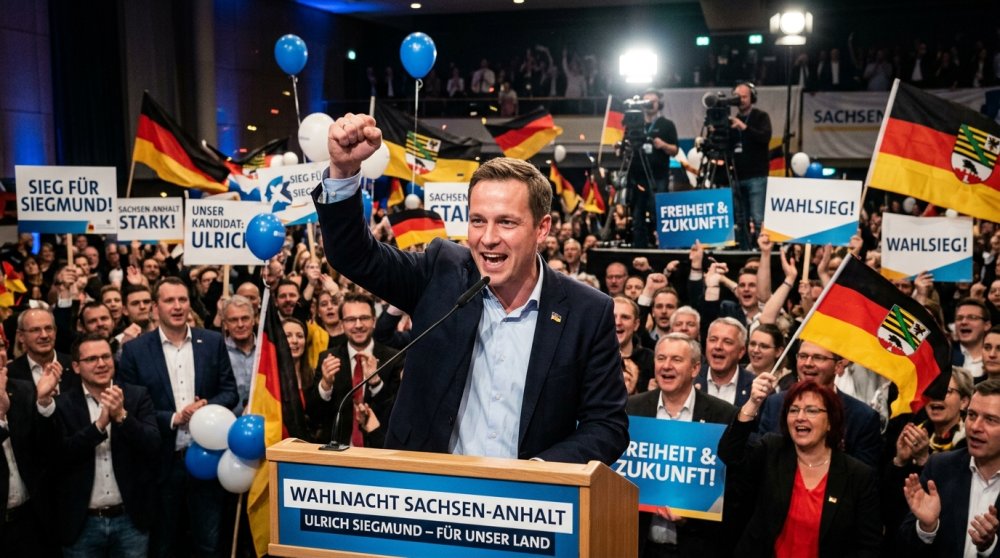
AfD sought to form the country’s first government of its kind since the end of World War II in 1945. Whether they would achieve an outright majority remained unclear as results continued coming in, but the message from voters was unmistakable.
Ulrich Siegmund, AfD’s anti-migration candidate for governor, declared victory in no uncertain terms.
“We have written history.”
Siegmund, 35, told public broadcaster ARD that voters had sent a clear message that “things cannot carry on like this.” He added that the result was “also a signal toward Berlin,” the seat of Germany’s increasingly unpopular national government.
“A very good campaigner for us in this election campaign was Friedrich Merz. Every day this man is in the chancellery is one too many,” he said of Germany’s embattled leader.
The election comes as Germans across the country express widespread frustration with their national government. Economic stagnation has left many working families struggling, and the political elite has offered little in the way of real solutions.
AfD aimed for an absolute majority in the state legislature to govern independently and overcome what critics call the “firewall” — mainstream parties’ coordinated refusal to work with them regardless of voter preferences. Final results would determine whether they achieved that goal.
Predictably, establishment politicians immediately circled the wagons and rejected any possibility of respecting voters’ wishes.
“AfD is a right-wing extremist party. It wants to leave the euro; that would be economic downfall … it works closely together with Russia, it wants a completely different social model,” said Franziska Hoppermann, the national general-secretary of Merz’s party. “We will not work with them.”
Forming its first state government would mark the biggest victory in the anti-migration party’s 13-year history. The party has tapped into deep frustration among Germans who feel abandoned by traditional politicians.
The projected result represents a devastating blow to Merz, whose center-right party has controlled Saxony-Anhalt for 24 years. Unlike several other European countries where populist movements have gained power, modern Germany’s political establishment has successfully blocked any challenge to their control — until now.
AfD is the largest opposition party in Germany’s national parliament and draws its strongest support in the formerly communist eastern regions. These areas remain less prosperous than western Germany decades after reunification, and residents feel their concerns have been ignored by distant elites.
The establishment has worked to marginalize AfD, with Germany’s domestic intelligence agency classifying its regional branch in Saxony-Anhalt as a confirmed right-wing extremist group. Officials cite the party’s criticism of mass migration from Muslim countries among their concerns.
The party promotes “remigration,” advocating for the deportation of immigrants who came to Germany illegally or who refuse to assimilate into German society.
Siegmund has made clear his top priorities include “a deportation offensive” and ending incentives that draw people to Germany to “exploit our social system.” He also wants to hold the regional public broadcaster accountable over allegations of “disinformation” in its coverage.
Germany’s 16 states wield significant powers, including control over security matters and education systems. This makes state-level victories particularly important for parties seeking to implement their vision.
Establishment media outlets have worked overtime to paint AfD as dangerous, pointing to controversies involving some party members. Critics dismiss these attacks as politically motivated attempts to silence legitimate voter concerns about immigration and national sovereignty.
Projections based on exit polls and partial counting showed AfD capturing just over 44% of the vote — more than double its performance five years ago in the region of 2.1 million people west of Berlin. The surge represents a political earthquake.
Merz’s Christian Democratic Union trailed significantly behind at 18%, losing roughly half its previous support. The Left Party, center-left Social Democrats, and Greens each polled around 9%.
Whether the BSW party would reach the 5% threshold needed to win seats remained uncertain. The projections showed AfD at least marginally short of an absolute majority initially, though final results could shift as counting continued.
Why It Matters
What’s happening in Germany is the same story playing out across the Western world. Working people are tired of being told their concerns about jobs, safety, and preserving their way of life make them extremists. They’re tired of open borders that benefit corporations and burden communities. They’re tired of watching their countries change beyond recognition while elites lecture them about tolerance. This election proves that when given the choice, regular folks will vote for leaders who actually listen to them — no matter how much the establishment screams about it.


-
 Entertainment3 years ago
Whoopi Goldberg’s “Wildly Inappropriate” Commentary Forces “The View” into Unscheduled Commercial Break
-

 Entertainment3 years ago
‘He’s A Pr*ck And F*cking Hates Republicans’: Megyn Kelly Goes Off on Don Lemon
-

 Featured3 years ago
US Advises Citizens to Leave This Country ASAP
-
 Featured3 years ago
Benghazi Hero: Hillary Clinton is “One of the Most Disgusting Humans on Earth”
-

 Latest News3 years ago
Nude Woman Wields Spiked Club in Daylight Venice Beach Brawl
-
 Featured3 years ago
Fox News Calls Security on Donald Trump Jr. at GOP Debate [Video]
-

 Entertainment3 years ago
Comedy Mourns Legend Richard Lewis: A Heartfelt Farewell
-

 Latest News3 years ago
Supreme Court Gift: Trump’s Trial Delayed, Election Interference Allegations Linger