Uncategorized
January 1, Restaurants Abandoning Table Manners Americans Grew Up With

Wyatt’s Take
- Traditional dining etiquette says wait until everyone’s done before clearing plates — modern restaurants ignore this basic courtesy
- Servers now swoop in the moment your fork hits the plate, leaving slower eaters feeling rushed and embarrassed
- Simple solution exists but most restaurants won’t train staff properly: just ask permission before grabbing plates
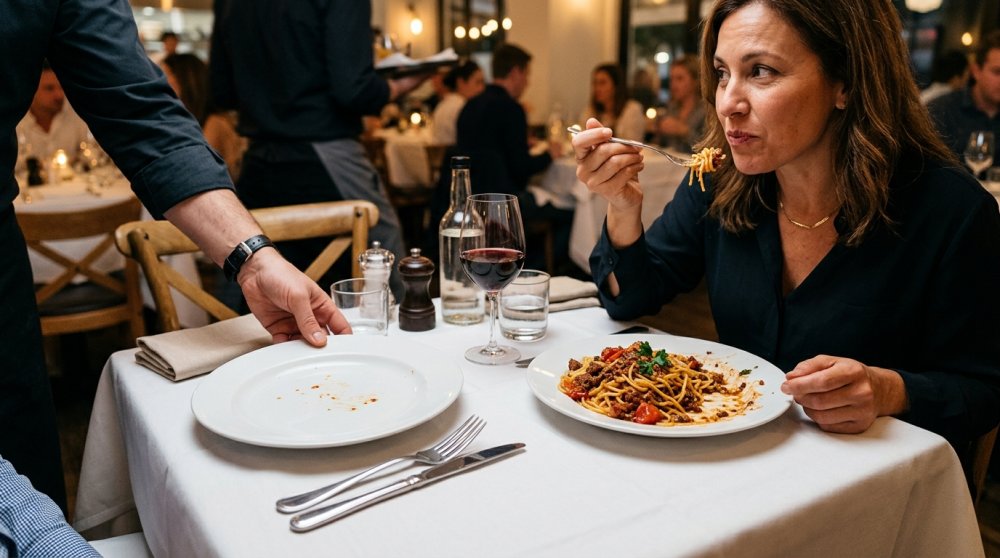
Your empty dinner plate vanishes from the table while your spouse is still eating. Sound familiar? It should — because restaurants across America have ditched the basic table manners our parents taught us.
Traditional dining etiquette is crystal clear: servers should wait until everyone at a table finishes eating before clearing any plates. But walk into most restaurants today and you’ll see something different — servers clearing plates one by one, turning what should be a relaxing meal into an awkward race against the clock.
“Everyone at the table should be finished before all the plates are cleared,” Jacqueline Whitmore, founder of the Protocol School of Palm Beach, told reporters.
The question every diner asks: Is my server being helpful or am I being rushed out the door? Turns out, it depends on whether the restaurant bothered training their staff.
Salar Sheik, who runs restaurant consulting in Los Angeles, claims diners shouldn’t automatically think cleared plates mean “get out.” He says servers are just trying to keep tables tidy and maintain flow.
“Clearing a plate is not necessarily an attempt to rush the guest or turn the table,” Sheik said. “Often, the server is simply trying to keep the table tidy, maintain the flow of service and prepare for the next course.”
But here’s the catch — knowing when to actually clear requires skill most servers don’t have. Sheik admits servers should look for cues: pushing plates away, silverware positioned together, sitting back from the table.
“We train the best service professionals to read the guest’s body language, pace and overall energy to determine when it is appropriate to approach and clear a plate,” Sheik said. “This is a subtle skill that only a small percentage of staff members truly master.”
Translation: most servers can’t read the room. And when they get it wrong, customers feel exactly what they suspect — pressure to hurry up and leave.
Getting it wrong “can make the guest feel rushed and is a sign of poor service,” Sheik admitted.
There are old-school signals diners can use. Crossing knife and fork on your plate means you’re still eating or just resting. Placing utensils side by side at the four-o’clock position signals you’re done.
Problem is, these customs aren’t universal anymore. Different countries, different restaurants, different rules — the basic courtesy Americans knew for generations is fading fast.
The fix is embarrassingly simple. Five words every server should know.
“If there is any doubt, the server should always ask, ‘May I clear this for you?'” Sheik said.
Just ask. That’s it. No mind-reading required, no awkward hovering, no rushing families through their meals. But in today’s fast-turnover restaurant culture, basic politeness apparently costs too much time.
Restaurants do have legitimate concerns about table turnover. No universal rule exists for how long parties should occupy tables — it depends on restaurant type, party size, and whether other customers are waiting.
Whitmore’s advice for diners: “read the room.” If people are waiting while you linger over coffee, be considerate. If the restaurant’s empty, enjoy yourself.
Fair enough. Americans understand give and take. What they don’t appreciate is being treated like inventory that needs processing.
Wyatt Matters
This isn’t just about plates and forks. It’s about the disappearing common courtesy that once defined American life. Our grandparents knew how to dine together without checking their phones or rushing through meals. Restaurants knew how to serve families without treating them like fast-food drive-through customers. Somewhere between efficiency and profit margins, we lost the simple grace of sharing a meal without feeling like we’re inconveniencing everyone. Maybe it’s time restaurants remembered they’re in the hospitality business — not the turnover business.


-
 Entertainment3 years ago
Whoopi Goldberg’s “Wildly Inappropriate” Commentary Forces “The View” into Unscheduled Commercial Break
-

 Entertainment3 years ago
‘He’s A Pr*ck And F*cking Hates Republicans’: Megyn Kelly Goes Off on Don Lemon
-

 Featured3 years ago
US Advises Citizens to Leave This Country ASAP
-
 Featured3 years ago
Benghazi Hero: Hillary Clinton is “One of the Most Disgusting Humans on Earth”
-

 Latest News3 years ago
Nude Woman Wields Spiked Club in Daylight Venice Beach Brawl
-
 Featured3 years ago
Fox News Calls Security on Donald Trump Jr. at GOP Debate [Video]
-

 Entertainment3 years ago
Comedy Mourns Legend Richard Lewis: A Heartfelt Farewell
-

 Latest News3 years ago
Supreme Court Gift: Trump’s Trial Delayed, Election Interference Allegations Linger
LC
September 3, 2026 at 8:25 am
It’s because most servers are young people who were never taught properly. Young people today are idiots. Sheik is an idiot. Of course he’s from Los Angeles so that explains a lot.